

IN January it will be 100 years since the audacious betting coup of 1927 for which Tenby Steeplechases are now best remembered.
Numerous accounts have been written about this episode in recent years, many of them greatly exaggerated, so the approaching centenary of ‘the Oyster Maid affair’ seems like an appropriate time to set the record straight and restore a few unfairly tarnished reputations.
By 1927, the annual Tenby race meeting was an established fixture on the sporting and social scene. Run under strict National Hunt rules, the two-day event was the highlight of Tenby Hunt Week and attracted large crowds, leading jockeys and equine entries from all over the country.
Years earlier this annual meeting had been held on a course laid out on The Marshes, but the threat of flooding was just one reason why a new course was needed. As the local press reported in 1872: “The races will not take place as heretofore on the Marsh, owing we believe, to the exorbitant sum required by the owner for the use of it, but on a new course at Knightson, about one mile from the town.”


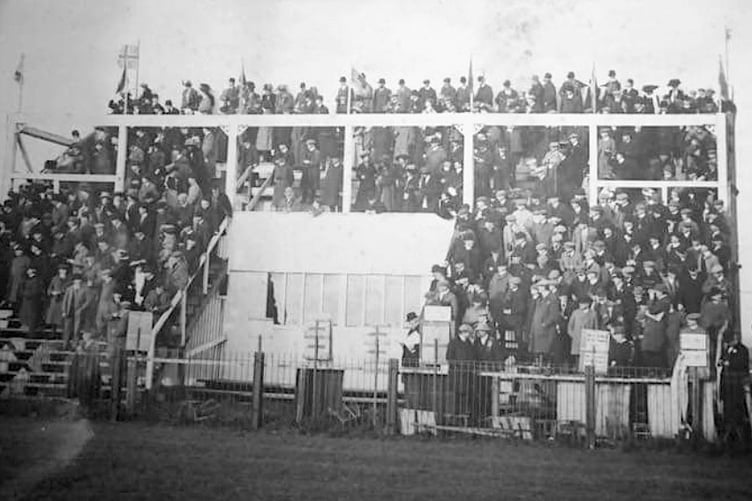
Consequently, for the next 65 years Knightson Farm, near New Hedges, was to be the home of Tenby Steeplechases, even acquiring a wooden grandstand capable of holding over 300 spectators.
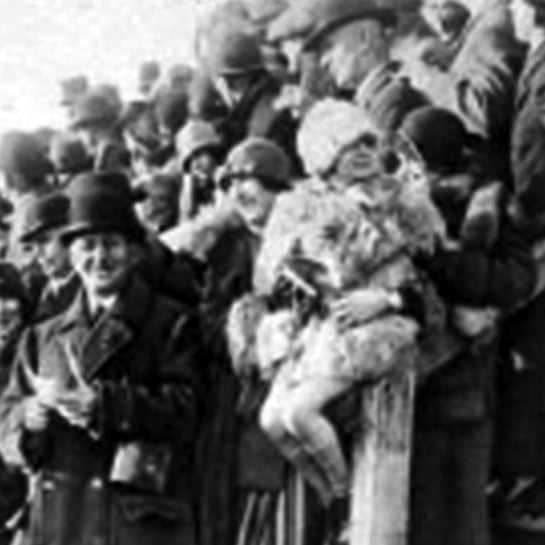
Prospects were excellent for the January 1927 meeting, with race secretary George Lort Stokes announcing a record entry of horses for the two-day event; meanwhile a good number of racing enthusiasts were arriving by every train. Unfortunately, the first day was marred by heavy rain, with winds so strong that a few marquees blew over. However, on the second day, despite the odd snow flurry, ‘the sun for the most part shone brilliantly and brightened up proceedings’, as one newspaper reported.
The race which has left its mark on history came on the second day, the otherwise unremarkable Licensed Victuallers Selling Hurdle for a prize pot of 50 sovereigns. Eleven horses were entered for the race overnight, but there were three non-runners due to the heavy going so eight lined up at the start, exactly half of them trained locally by David Harrison at his nationally renowned racing stables in Upper Frog Street, Tenby, adjacent to the De Valence Pavilion.
Least fancied of the four was Harrison’s own horse, Fairy Light, but there was some money for the five-year-old Orange Plume. Owned by wealthy North Wales industrialist Henry Dyke Dennis (who had a second home near the racecourse, at Park House), Orange Plume was ridden by the owner’s son Pat, a keen amateur jockey.
But the two Harrison-trained runners that attracted most attention were Oyster Maid, a four-year-old mare owned by Ben Warner from Newbury and ridden by future champion jockey Billy Stott, together with the odds-on favourite Bubbly, owned by former Worcestershire and England cricketer Ted Arnold and with Tenby-born Grand National winning jockey F B ‘Dick’ Rees in the saddle.
While most experts in the national newspapers tipped the classy veteran Bubbly to win, one or two pundits went for Oyster Maid, which opened in the betting at 10-1. There was little on-course support for the latter, however, and her odds drifted to a starting price of 100-6. Bubbly went off at 2-5 on.
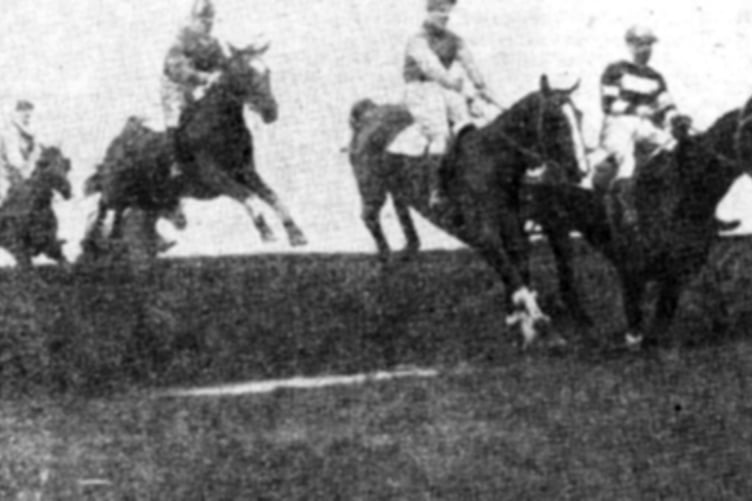
In the race itself, Oyster Maid and Bubbly entered the home straight neck and neck, but Oyster Maid – eight years younger and carrying 6lb less than her rival – pulled clear to win by five lengths. With Orange Plume finishing third it was a clean sweep for the Tenby-trained horses.
While the result raised a few eyebrows among spectators, it was certainly not a shock – the previous race had been won by a 20-1 outsider, after all – and neither the race stewards nor the newspaper correspondents covering the meeting considered that anything out of the ordinary had taken place.
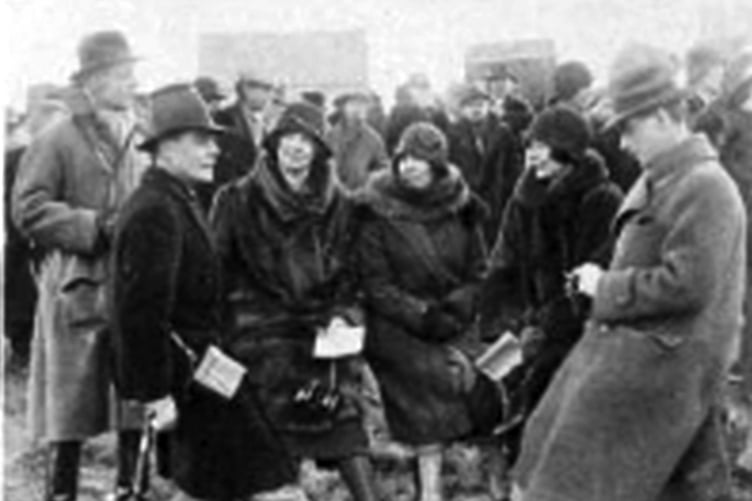
It was only a day or two afterwards that stories of a major betting coup began to appear in the national press. These revealed that immediately before the start of the race, substantial bets (to win and each way) had been placed on Oyster Maid with big bookmaking firms around the country. Normally these bets would have been rapidly communicated to the on-course bookies who would have adjusted the Oyster Maid odds accordingly, giving a much less generous starting price.
However, communication with the Tenby course was never easy at the best of times and, as the Daily Express reported two days later: “There had been difficulty in getting messages to and from the course on both afternoons owing to mist on Wednesday, and a violent snowstorm and gale on the concluding day. This hampered the signallers who operate ‘The Blower’- as the system is called by which money from bookmakers’ offices is returned rapidly for reinvestment on the course. The result was that none of the money invested ‘away’ got back to the course.”
While the national bookmakers raged, there was nothing they could do about the situation – no laws had been broken, so the bookies had to grit their teeth and settle bets at the official starting price of 100-6. It was reported that ‘as far afield as Dublin one bookmaker had to part with four figures, and it was the same in London, Epsom and elsewhere’.
Credit for the coup went to Ben Walker, owner of Oyster Maid and a professional gambler who held accounts with all the big bookmakers, thus allowing him to make a series of last-minute telegram bets. It seems likely that Warner had a tip-off from the stables that his mare was performing well on the training gallops, and he may also have known about the problems being experienced by ‘The Blower’.
Putting these facts together, Warner placed his bets and duly collected a small fortune – a smart betting coup by an inveterate gambler and all perfectly legal.
For the next 35 years little more was heard of ‘the Oyster Maid affair’ until an article by racing correspondent Walter Meeds appeared in The People newspaper in 1962.
Writing about racecourse gambling over the years, he cited the Tenby betting coup of 1927, suggesting darkly that there was more to it than simply an owner acting on some inside information. ‘The most significant thing about that day was that, as a racing venue, Tenby disappeared for good after that meeting,’ he declared.
This was totally incorrect. To start with, the 1928 meeting was well supported and a great success with near record entries, despite the untimely death a few months earlier of Tenby town clerk George Lort Stokes, the driving force behind the event for many years.
In fact, Tenby Steeplechases carried on well into the 1930s, finally coming to an end in 1936 due to the financial impossibility of sustaining a steeplechase course only licensed to hold one meeting a year, especially in the Depression.
However, The People article had done its damage, and since then various writers have perpetuated the myth that ill-feeling aroused by the Oyster Maid race precipitated the immediate end of Tenby Races, some even adding that it caused the demise of Monmouth, Cowbridge and Cardiff (Ely) National Hunt meetings as well!
With few facts to work with, recent writers with books to sell and columns to fill have allowed their imagination to run riot, the betting coup increasingly being termed a ‘scam’ or a ‘sting’.
Successive retellings have added lurid embellishments to the story – several refer to on-course bookmakers scarpering across Cornish Down to avoid paying out large sums, when, in reality, few punters at the meeting backed the winner.
How much was taken from the national bookmakers? No-one really knows, but the amount has grown over the years with each retelling, from an estimated £10,000 at the time rising to impossibly vast amounts more recently. And nearly every modern version of the tale has a mysterious ‘Tenby publican’ – always unnamed, of course – winning a huge sum on the race, as much as £60,000, or well over a million pounds in today’s terms.
Why didn’t the message from the bookmakers’ offices get through? Not content with the version of events accepted at the time – that bad weather intervened – various writers have come up with their own melodramatic theories. A story in the Yorkshire Evening Post claimed that the telegraphist was unable to contact the course because she had just been handed two pages of the Bible to transmit, while elsewhere you can read about a motorcyclist carrying a vital phone message being refused admission to the course.
Everyone loves a conspiracy theory these days, especially the online community, so you can discover all kinds of fanciful stories of how the race was fixed with the connivance of just about everyone connected with it – jockeys, trainers, racecourse officials and owners. According to one particularly far-fetched account: ”All seven opposing jockeys were paid not to win, and the starting price reporter was paid at the same rate to return inflated odds on the winner.”
Elsewhere you can read that Ben Warner sent a man down to the final hurdle to offer a £100 bribe to any jockey threatening to beat Oyster Maid!
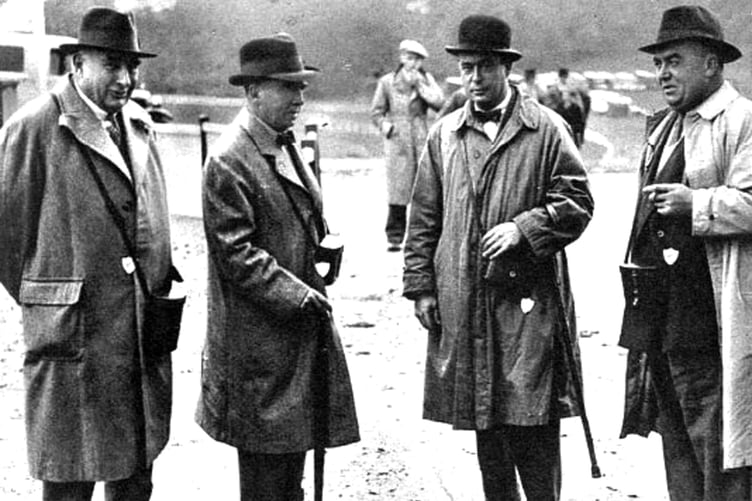
Inevitably, as trainer of the horses involved, David Harrison has come in for special attention, the suggestion being that he was somehow involved in a ‘scam’. This is nothing less than a slur on the memory of one of Tenby’s most respected residents - a man who was so highly regarded across Pembrokeshire that he was made High Sheriff of the county in 1918.
As a trainer of long standing, Harrison was equally well regarded, sending out several Grand National runners for Lord St David’s of Lydstep House, among others. To hint that he, perhaps in cahoots with George Lort Stokes, was involved in race fixing, as some have done, is obviously ludicrous, as is the suggestion that champion jockey Dick Rees – the A P McCoy of his day – would risk his career and reputation by throwing a race.
Fortunately, not all writers have fallen into the trap of believing that skullduggery was afoot. As respected racing correspondent Eric Graham has written: “Some people should be heartily ashamed of themselves for the stories that were, and are, circulated about the people involved.”
And this is, of course, the point. Suggesting, as so many have done, that there was a grand Tenby-based conspiracy to defraud the bookies may seem like harmless fun, but it damages the reputation both of the town and of any number of honest and worthy townspeople and race officials who worked selflessly over the years to make a success of Tenby Steeplechases and who are no longer around to defend themselves from unfounded allegations.
Let’s use the centenary of the famous race to call a halt to this fake news bandwagon, stop rewriting history and accept the fact that the ‘Oyster Maid affair’ was simply a smart betting coup and nothing more.
Comments
This article has no comments yet. Be the first to leave a comment.