

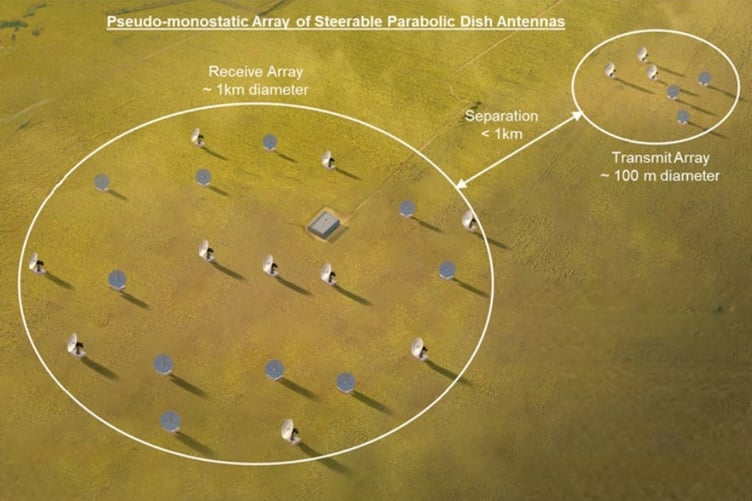
THE Ministry of Defence has launched an early-stage consultation for a deep-space radar site at Cawdor Barracks, Pembrokeshire, aiming to bolster the UK's space monitoring capabilities.
A pre-application consultation on the UK Government website, runs up to March 23, with the MoD intending to submit a formal planning application to Pembrokeshire County Council after that date.
Proposals for a worldwide network of sensors called the Deep Space Advanced Radar Concept (DARC) to track active satellites and other objects, and the Brawdy connection, first came to light locally when a scoping opinion request was made by the MoD to the council back in 2023, as reported by the Local Democracy Reporting Service.
The scheme would utilise three sites worldwide, in the USA, the UK and Australia “enabling 360-degree coverage of the sky at all times of day and under any weather conditions”.




In late 2023, Cawdor Barracks was identified as the preferred UK site by the-then UK Defence Secretary, Grant Shapps.
The following May, Campaign group PARC (Pembrokeshire Against Radar Campaign) Against DARC was founded to oppose the 27-dish radar station it believes will threaten local tourism, health, and the environment.

A supporting statement accompanying the consultation, through Montagu Evans LLP says: “The Deep Space Advanced Radar Capability proposal will enhance the UK’s ability to detect, identify, and track objects in Earth orbit, including satellites, space debris, and potential threats.
“This capability is vital for ensuring the resilience of UK space systems, enabling the UK to secure attribution, maintain stability and provide information for managing emerging challenges. Fundamentally, the project forms a key site that will support wider international space traffic management and enhance collective international security.
“As part of the ongoing investment into this domain, the UK has been working with its allies to identify a location for a new deep space monitoring facility to protect and defend both military and civilian infrastructure that supports our way of life.”
It adds that, as well as the civilian importance of satellite technology, “there is the strategic importance of secure communication for command-and-control activities undertaken by the UK military,” adding: “This not only serves to support operations for and with our allies across the globe, but also the day-to-day security of the nation.”

It says there is a risk of collisions in the near-30,000 space objects in orbit that could produce a chain reaction and adds: “The proposed DARC project will form a cornerstone of the UK’s ability to detect, identify, and track objects in Earth orbit, including satellites, space debris, and asteroids. This capability is critical to protect and defend the services provided by satellites, ensuring continuity and resilience against collisions or debris-related incidents.
“Without DARC, the UK faces a significant risk of losing access to these vital services, which would have severe consequences for national security, economic stability, and public safety.”
Find out about planning applications that affect you by visiting the Public Notice Portal.
A supporting statement from the United States Space Force Space Systems Command says the proposed equipment is International Commission on Non-Ionising Radiation guidelines for limiting exposure to electromagnetic fields compliant.
Comments
This article has no comments yet. Be the first to leave a comment.