
We win an award!
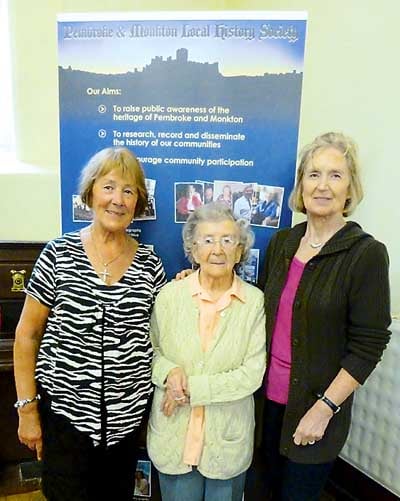
Thursday was a proud day for our society when we were awarded a Certificate of Commendation by Pembroke Town Council. Civic awards are made annually in recognition of the voluntary contribution individuals and organisations make to the community. Our president George Lewis received the award on behalf of the society from the Mayor, Clr. Keith Nicholas, at the awards evening at Pembroke Town Hall. The History Society has been in existence now for over four years and during that time we have worked extremely hard at promoting our great heritage through events, exhibitions, publications and most recently organising Pembroke Museum. We have done this by working in partnership with the town council and other voluntary heritage organisations in the community and just goes to show what can be done by working together. Our emphasis has always been community, bringing people together through our fundraising events, local history coffee mornings and quiz nights, as well as supporting other community groups and participating in local events.
Stories of the Pembroke River
Last Saturday (May 3) was the last local history coffee morning of the spring programme before breaking for the summer. It was good that so many turned up to attend especially as Stuart and I were giving the talk - a mixture of talk, film and recordings about the Pembroke River. In our history, the Pembroke River was vital to the development of Pembroke itself - sustaining communities, facilitating communication by providing the means of transportation and trade. On the downside, the river was an avenue for unwelcome invasion, but these were all factors which helped mould the place in which we now live. We looked back at the Pembroke River through time, from the beginnings of human habituation some 10,000 years ago to the present day. It is quite a story so I put together an exhibition to accompany our presentation as the subject is so vast for an hour long talk! The story of Pembroke really began in 1093 when the Normans invaded and built their castle on the limestone ridge above the Pembroke River. Pembroke was the Norman powerbase in South West Wales and the town grew prosperous through its sea trade and privileges granted by royal charter. However, disaster struck in 1349 when an unwelcome invader sailed up the Pembroke River in the shape of the black rat carrying the Asian fleas which brought plague to Pembroke, wiping out a third of its population. As the Tudor Age dawned with the birth of Henry VII in Pembroke Castle in 1457, Pembroke was still in a severe depression. It was dealt a further blow by his son Henry VIII who, in 1536 and 1542/3, passed two Acts of Parliament uniting Wales and England. Pembroke's special privileges were taken away and Haverfordwest became the county town. However, things were later to take a turn for the better and in the 18th century we see Pembroke once again thriving as a port, reliant for its prosperity on its great river.

Old tales
At our last talk on April 16, Richard Davies gave a fascinating account of the French invasion of Fishguard in 1797. Pembroke River, too, had its part to play in that famous episode in Pembrokeshire's history and a romantic one at that. One of the stories related was the escape of the French prisoners from Golden Prison and they were able to make their getaway down the Pembroke River. The narrator of the tale was Rose Blackburn, our Town Crier, and was a recording I made earlier. Other stories were not so happy. As well as boats sailing up and down the Pembroke River, there were ferries across it at various points. One of these was at Bentlass which in 1889 was scene of a very great tragedy: the sinking of the ferry with all lives lost, most of them farmers' wives returning from market at Pembroke Dock. A very dramatic, but anonymous contemporary poem commemorated this terrible event, and a few years ago, I asked the late Brian Griffiths to record it as he had such a wonderfully dramatic voice. Thanks were given to Gwen Griffiths for permission to use it.
A Hive of Industry
The Pembroke River is a really interesting place and, on a low tide in dry conditions, it is possible to walk along the shoreline as far as Ferry Road. There you can see the remains of past industry - all linked to Pembroke's maritime life. Quarry workings, inlets for the quarry boats, limekilns and even a boatyard. Hard to believe now, but Jacob's Pill was once a shipyard where was built the Hiei, the first ship of the Japanese navy. There are tales of smuggling and piracy too! There are so many stories associated with the Pembroke River.
Recording memories of the River
We have a collection of recorded memories of the Pembroke River and we played some of these as well as inviting contributions - memories of fishing, swimming, diving off the mill, boating, watching the coastal traders unload their cargoes. The river played such an important part in the lives of Pembroke people when it was tidal and clean. Now a barrage blocks the river and this has upset its natural balance - it is hardly a place to swim nowadays! Once the lifeblood of Pembroke, boats are prevented from sailing up to the quays and the only time you may see them now is the set piece events like the River Rally run by the West Wales Maritime Heritage Society and sponsored by Pembroke Town Council. July 26 is the next event so make that a date in your diary and, if you do happen to own a boat, join in! It is quite an experience.
Next events
Friday, May 16, 7.30 pm, at Monkton Church Hall, there will be a talk 'A History of the Castlemartin Tank Range' by Craig Stringer, of PCNP. Free admission. Friday, May 23, quiz night and social at Monkton Church Hall. £4 includes a delicious buffet. Bring your own bottle if you wish.
Contact
If you have any stories, photographs or feedback for this column, please contact me, Linda Asman, on 01646 622428, email [email protected]">[email protected] and visit our website http://www.pembrokeandmonkonhistory.org.uk">www.pembrokeandmonkonhistory.org.uk
Comments
This article has no comments yet. Be the first to leave a comment.