
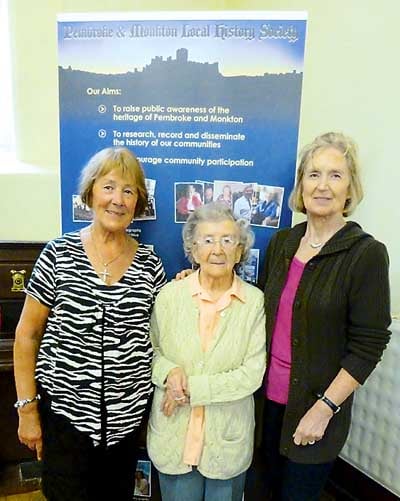
St. David's Day is well celebrated nowadays and each year our society organises something with a Welsh flavour to mark the event.
Instead of the usual Coffee Morning, this year we put on a St. David's Day Lunch, which proved very popular, a lovely community get-together where people could meet up with friends and acquaintances.
The food was excellent, with soup cooked by Rhian Nash and Pauline Waters accompanied by much Welsh fare and cakes brought in by so many. Accompanying the meal were various stalls and an exhibition of 19C Welsh costume which we now have on loan from Pembrokeshire Museums Service.
This was a joint fundraising event with Monkton Priory Church and together we raised a total of £329.50 for the church.

The History Society has much support in the community. We are not an inward looking organisation: quite the opposite, as we aim to work with other voluntary community groups, helping where we can.
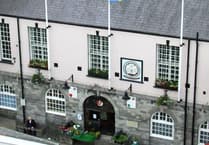
On Tuesday, it was Pancake Day at Pembroke Town Hall, organised by the Pembroke committee of Macmillan Cancer Support. We gave assistance and displayed our Welsh costume exhibition to add interest to the event. It was a marvellous morning -the pancakes were good too!
Pembroke Museum
Part of that Welsh costume exhibition can now be seen in Pembroke Museum, which is in the old Courtroom in Pembroke Town Hall. The collection belongs to Judy and St. John Stimpson and it was placed in Scolton Manor on the closing of their Museum of the Home, as Pembroke had no museum of its own in which to deposit it.
We are also very grateful to them for allowing us to copy their collection of Welsh prints and photographs which we will also be assembling for exhibition.
At the moment, during winter months, the museum is open three mornings per week on Tuesdays, Thursdays and Fridays.
It is 'work in progress' and all are welcome to come in for a browse and a chat - and perhaps add to what we have. The Museum is a purely voluntary venture, supported by Pembroke Town Council, and all help is welcome.
Welsh Costume
It is sometimes claimed that the Welsh costume is a Victorian invention and many photographs are obvious stereotypes: Welsh ladies at their tea parties, knitting and posing with baskets of wares are favourite subjects, and they are often photographed in a studio setting.
However, the costume is actually based on clothing worn by Welsh countrywomen during the early 19th century - a striped flannel petticoat worn under a flannel open-fronted bedgown with an apron shawl and cap.
As such, it differs little from the clothes worn at that time in other rural areas of Britain. It was made from locally produced cloth, surviving in isolated rural areas unaffected by 'modern' influences and changes in fashion.
The Welsh Hat
That tall hat with the stiff brim looks a most unlikely item of dress, but has become a Welsh icon. According to the National Museum Wales' website, 'the hats generally worn were the same as hats worn by men at the period.
'The tall 'chimney' hat did not appear until the late 1840s and seems to be based on an amalgamation of men's top hats and a form of high hat worn during the 1790-1820 period in country areas.'
There is another type of hat seen in many photographs, a flat felt hat on which women balanced the heavy baskets of cockles which they gathered and took to market, often walking long distances. The famous Llangwm cockle women wore these.
Although the costume was widely worn during the 19th century, there were influences at work helping to promote and preserve it.
Certain members of the gentry, especially Augusta Hall, who later became Lady Llanover, considered it important to encourage the use of the Welsh language and the wearing of an identifiable Welsh costume: she made her home at Llanover House, near Abergavenny, a centre for the promotion of Welsh culture.
The rising tourist trade also helped in popularising the idea of a typical Welsh costume. Prints and photographs were produced for the growing picture postcard business. While this contributed to the stereotyping of one style of costume, as opposed to the various styles which were worn earlier in the century, it did ensure that Wales retained a national costume, something England was never able to do.
Changing Times
Looking at the pages of schoolchildren dressed up in the national dress in the pages of last week's edition, it would seem that the Welsh costume is more popular than ever.
I cannot remember ever celebrating St. David's Day in my primary school years, although later, during my time in secondary school, we did have an eisteddfod. In those days, brought up in Tenby, not a word of Welsh was spoken and there was no Welsh taught in schools. There were no bilingual place names, signs and forms. We were very much 'Little England beyond Wales'.
Little England Beyond Wales
All this has its origins in the Middle Ages, when following the Norman conquest in 1093, the victors established a powerbase at Pembroke from which they spread their influence over the whole of south Pembrokeshire and south-west Carmarthenshire.
Pembroke was granted royal charters bestowing on it special privileges so as to encourage settlers who would, in turn, provide a ready supply of men to defend the newly-won territory. A new colony of English and Flemings was established, driving the native Welsh from their lands. The Welsh language was displaced completely and South Pembrokeshire became English, both in language and custom: it was later dubbed 'Little England Beyond Wales', a name which persists to this day.
The Landsker
The Landsker is the name given to the imaginary line, which roughly stretches from Amroth across to Newgale, dividing the 'Welshry' in the north from the 'Englishry' in the south - and until recent years that difference was very significant.
Now, with the resurgence of the Welsh language, the difference is not as pronounced. I do think, however, that it is not quite right to translate all our English place names, which have evolved over centuries and are often a mixture of many cultures, into Welsh.
I feel this is a denial of our heritage - many of these settlements were never Welsh nor were they known by Welsh names.
Before anyone attacks me on this (we have to so careful to be pc nowadays!), I have taken the trouble to learn Welsh, albeit not very successfully, and I am a great advocate for Welsh education.
My grandchildren are being educated entirely in Welsh at Golden Grove School and I hope they will develop as fluent Welsh speakers.
This is a positive way of promoting the Welsh language and I have great admiration for their teachers and the results they achieve. We are lucky to have such a fine school in Pembroke.
Contact
If you have any stories, photographs or feedback for this column, please contact me, Linda Asman, on 01646 622428, email [email protected]">[email protected] and visit our website http://www.pembrokeandmonkonhistory.org.uk">www.pembrokeandmonkonhistory.org.uk
Next Event
Tonight (Friday), we have a Quiz Night at Monkton Priory Church Hall, at 7.30 pm.
£4 admission includes a buffet.
Teas and coffees included, but bring your own bottle if you wish.
Comments
This article has no comments yet. Be the first to leave a comment.