
A Great Turnout!
We were expecting a lot of interest in our World War One Commemoration Event in Pembroke Town Hall last Saturday, but were taken aback by the large numbers who came despite the inclement weather!
Around 150 people supported the event, which just goes to show the interest there is in commemorating the First World War - I think we all feel it so important that we remember the sacrifice made by so many during that terrible conflict.
A Community Event

Pembroke Town Council sponsored the event, which saw a coming together of local heritage groups in support - the West Wales Maritime Heritage Society, Pembroke Civic Trust, Owen Vaughan, Carew Cheriton Control Tower, Colin Friend of the Royal Artillery Association, Keith Johnson of Pembrokeshire Life all put up stalls and displays.
We are also working in conjunction with Planed, who are co-ordinating a series of Commemorative Talks on the Great War, and Dyfed Archaeological Trust.
Ken Murphy
Opening proceedings, Ken Murphy, of Dyfed Archaeological Trust, spoke about the Trust's scoping study which is seeking to assess the archaeological impact of the First World War on Pembrokeshire.
Last February, some of our society attended a meeting held in the Picton Centre, Haverfordwest, to launch the project, and Ken was able to give an update on its progress.
One of the sites Ken described was at Penally, where the remains of WWI practice trenches are a scheduled ancient monument. Until recently I knew nothing about these and went to take a look a few months back and take photographs.
I was born and brought up in Tenby and had walked past them on countless occasions without even knowing they were there!
What other physical remains of the war are there around us we know little about?
The Penally Trenches
Penally is of particular interest to Jackie Crossman, whose grandfather Stanley Rowlands, was stationed there and she was able to produce this photograph which was taken of him in Penally Camp. Jackie also informed me that he enlisted in the 3rd/4th Battalion of the Welsh Regiment. After serving in the trenches in France, where he was wounded, he was commissioned as a Captain and became Commandant of the Signals Section at Penally. Stanley later became headmaster of Monkton Mixed Junior School and was popularly known as Stanner Rowlands.
Simon Hancock
Next, Simon Hancock gave us a riveting talk about the Home Front in Pembrokeshire during the First World War.
The First World War is something of a passion with Simon, who has spent countless hours during the past five years researching its impact on the civilian population of Pembrokeshire. This was his first public talk reflecting that research.
Simon's wide ranging talk began with the visit of the German cruiser, SMS Hertha, to Milford Haven in 1912, at a time of intense British-German rivalry.
At first, military recruitment was by voluntary enlistment but, with mounting casualties, conscription was introduced for the first time and Military Service Tribunals were set up in each locality. The civilian population was affected as never before by war and Simon looked at many aspects of life on the Home Front, including the role of women and their contribution to the war effort, nursing, military camps, propaganda, living standards, food control, rationing, the growth of the state through new criminal offences like having lights showing at night.
The effect of the U-boat war off the Pembrokeshire coast was also considered, as were the coast watchers, airships and aircraft employed to counter the menace.
Many fascinating and hitherto untold stories of the war were related and images, artefacts, postcards and photographs of objects were lavishly displayed throughout, adding greatly to the interest generated by the talk.
Perhaps the most poignant artefact was a home-made Christmas card dating from 1927, made by the five caretakers at the closed Pembroke Dockyard. Simon felt that it could be argued that the war hastened the demise of the dockyard caused by the massive increase in public spending and debt which had to be curtailed after 1918.
I have to say, Simon is an excellent speaker and the enthusiastic applause he received reflected this.
Exhibition
It is important that we really make an effort to gather in material to discover the impact of the war, especially on Pembroke and district, so that we can contribute to these county-wide initiatives.
An exhibition of local photographs was displayed in the Main Hall; hopefully we can build on this during the year. The exhibition will remain and can be seen by visitors to the Town Hall, during times, of course, when the hall is not in use - please help by bringing in photographs, memories of family who served and memorabilia.
Trench Art
One artefact produced was an example of trench art belonging to Mel Phillips, a letter opener dated 1918. Not knowing much about trench art, I asked Mel to enlighten me.
She writes: Trench Art dates as far back as the Napoleonic Wars, but somehow has now become synonymous with the First World War. Most of us think that trench warfare consisted of one continuous and unrelenting stream of gunfire and shell bursts, but this was not the case. Men suffered long periods of inactivity, sometimes waiting months for orders to go 'over the top.'
During these stressful and anxious times of waiting, many soldiers who had a flair for art and creativity occupied the long tedious hours fashioning ornaments and gifts for loved ones out of what was called 'battle scrap.'
Battle scrap mainly consisted of spent brass cartridge shells. These lumps of twisted metal existed in abundance and were usually gathered for recycling. Brass was a valuable commodity and was used for melting down and forming new weapons of war. Some stray shells landed in the trenches and the soldiers secretly filched them.
The officers knew about this practice, but turned a blind eye, actively encouraging the men to work with their hands. Better to have them pinch a few shells and bits of waste metal and mould them into decorative shapes than be idle. Long periods of idleness were no good for morale. Practical activities were seen as therapy.
Not all souvenirs were made of brass. Some men made carvings from discarded pieces of wood or fragments of animal bone that littered the ground, whilst other less skilful men made use of discarded tunic buttons.
These they pressed into the hard clay of the trench to make a mould and then filled the mould with molten lead collected from other spent missiles.
Most of the souvenirs were sent home to the soldier's families, whilst other men sold their creations to less gifted and artistic men, usually for cigarettes and alcohol. Common trinkets included letter openers, matchbox holders, candlesticks and vases.
Raising money for the Museum
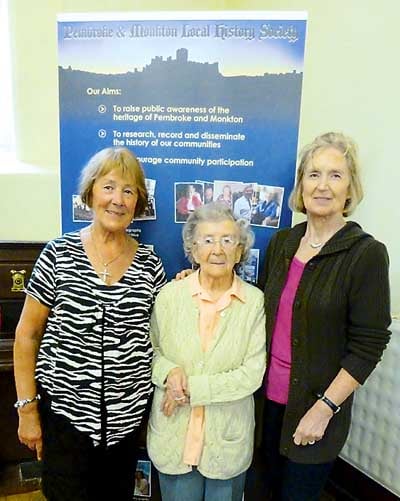
Finally, thanks must also go to the ladies of the Pembroke and Monkton Local History Society Committee for arranging the Coffee Morning during the event. A sum of £203 was raised in support of Pembroke Museum.
The Museum is now open three mornings per week, Tuesdays, Thursdays and Fridays, during the winter months. Do call in if you can help with this project.
Next Event
We have our AGM and members night on Friday, February 21 - George Lewis will be providing the entertainment with a light-hearted, humorous talk on 'Edwardian Inventions'.
That will be in Monkton Church Hall at 7.30 pm - free entry and open to non-members as well. Subs are due, only £3 p.a. if you wish to join us and support our work.
Contact
If you have any stories, photographs or feedback for this column, please contact me, Linda Asman, on 01646 622428, email [email protected]">[email protected] and visit our website http://www.pembrokeandmonkonhistory.org.uk">www.pembrokeandmonkonhistory.org.uk
Comments
This article has no comments yet. Be the first to leave a comment.