
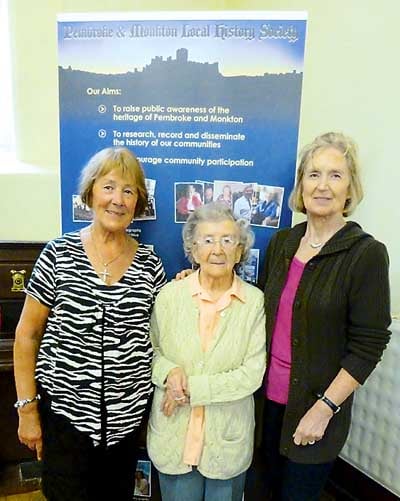
Last Saturday, we recommenced our monthly local history coffee mornings at Monkton Priory Church Hall. Unfortunately, our programme met with a hiccup when Rosalie Lilwall, of Dyfed Family History Society, was unable to speak to us as originally advertised. She will come next month instead on Saturday, November 2. Hunting around for an alternative, I came up with the idea of an exhibition of old prints of Pembroke. Before I go any further, I must acknowledge the contribution of Judy and StJohn Stimpson for allowing me to scan their collection of prints in the first place and also for providing me with much information about them.
Our heritage
Pembroke has an amazing heritage. The history of our nation can be told here - the Norman Conquest, the mighty Earls of Pembroke (including William Marshall, regent of England), the birthplace of the Tudor dynasty, the Civil War and much more. On top of all that, we have a great artistic heritage. While in the distant past, men came here to fight, in more recent times they came to paint inspired by the once mighty castle which had been left in a ruinous state following the 17th Century Civil War.
The Romantic Movement

In the 18th century, attitudes in art and literature were changing. The Romantic movement developed as a reaction to industrialisation and rationalism: artists went in search of the picturesque, wild nature and ruins - in literature also, the gothic novel grew popular, name 'Gothic' referring to the medieval buildings in which many of these stories took place. What better subject than the magnificent ruin of Pembroke Castle in its natural, unspoilt setting! Like a magnet, it attracted most of the great topographical artists of the 18th and 19th centuries.
Samuel and Nathaniel Buck
During this period, mass production of works of art now became possible with the development of printing techniques. Views of buildings, towns and the countryside by eminent artist were now made available to the many instead of the few well off enough to purchase unique works of art. Pioneers in the field were the Buck brothers, Samuel and Nathaniel, who were way ahead of any other print makers in seeing towns and ruins as suitable subjects for their pictures. Their output was prolific, creating a record of over 500 ancient monuments and towns in England and Wales.
Pembroke Prospect
The 'Pembroke Prospect' is a wonderful print which shows us a sweep of Pembroke in 1747; only a section is printed here. It shows us that Pembroke was then a prosperous port, large sailing ships coming to trade at the quays (no harbour then, the boats was beached and unloaded with horse and cart); Pembroke Castle is partly in ruins; Monkton has its own quay and further along is the partly ruined Priory Church. In the background stands St. Daniels Church. A charming group of people stand in the foreground dressed in contemporary dress of the well to do. We catch a glimpse of what Pembroke may have looked like then: in the mid-18th century, it was very much enclosed within its walls and surrounded by countryside.
Paul Sandby
Another 18th century artist of note who came here was Paul Sandby, who has the distinction of being the founder of the Royal Academy. He made a lot of drawings of Pembroke and we have a number of prints based on these. The print here is taken from the Eastern end of the Mill Bridge (1778): the old North Gate can clearly be seen, the last of Pembroke's medieval gates. It was demolished around 1820 to improve access for traffic. The building on the bridge is the old mill, a much smaller affair than the great Victorian Mill which replaced it, and which we are accustomed to see in old photographs. Another interesting feature of this print is, in the background, the dovecote on Priory Farm. In contrast with Buck's stylised figures, the people portrayed by Sandby are ordinary folk going about their business - one is fishing while the reaper stops by to chat to the lady who is playing with her baby.
Charles Norris
An artist whose work I am very familiar with is Charles Norris who was born in London in 1779, but later settled in Tenby. He built himself a house in nearby Waterwinch, a fine house which I remember well: it has been spoilt in more recent years with unsympathetic extensions. I was brought up in Tenby and, while in the sixth form in Greenhill, I used to help out at Tenby Museum. One of my jobs was to help catalogue Charles Norris' paintings.
Norris lived during a time of great change, when Tenby was being virtually rebuilt into a fashionable seaside resort. The casualties were its medieval and Tudor buildings, pulled down to make way for the redevelopment and Norris made it his mission to record them for posterity. He was a prolific painter who also painted all around Pembrokeshire, including Pembroke: his prints are some of the finest we have and certainly my favourites. The picture printed here is of the millpond looking up towards the castle, the town walls on your left. No millpond walk then, a modern addition and the town walls, as now, not in a very good state. A group of men stand by their boat and remind us that this had always been a waterway.
J.M.W. Turner
Of course I have to mention the great Turner who produced a fantastic number of drawings and watercolours for the print industry. His style is unmistakeable, using artistic licence to create amazing atmospheric effects. He visited Pembroke a few times, this print of Pembroke Castle was made in 1826 - what rough seas and amazingly large fish! This also serves to remind us that art is more important to the painter than realism - paintings are not photographs!
Pembroke Town
Pembroke having such a picturesque castle meant that artists mainly came to paint just that, leaving the town more or less forgotten. So many prints give a similar view. However, in 1818, J. P. Neale made this print which must be one of the earliest views of the town, although it does not appear to be a very accurate representation. More accurate perhaps is Henry Gastineau's Pembroke of 1830 in which we see a very recognisable Main Street. Gastineau was a most prolific artist who painted many views of Pembroke.
The advent of Photography
Printmaking was both time consuming and expensive. Photography developed around the mid-19th century and eventually the photographic picture postcard replaced the artists' print.
Next society event
On Friday, October 18, at 7.30 pm, we will be having an evening of Pembroke's Ghostly Tales by candlelight in Monkton Church Hall. Enjoy a drink of hot chocolate and if you have a story to tell please share it with us. Free entry, all welcome.
On Friday, November 15, we are organising something completely different - a Victorian Murder Mystery in Pembroke Town Hall with the SeeSaw Players (Victorian dress optional). Also included is a two-course meal. Tickets are now available and must be sold in advance as places are limited.
Contact
If you have any stories, photographs or feedback for this column, please contact me, Linda Asman, on 01646 622428, email [email protected]">[email protected] and visit our website http://www.pembrokeandmonkonhistory.org.uk">www.pembrokeandmonkonhistory.org.uk
Comments
This article has no comments yet. Be the first to leave a comment.