
In 1939, the War Office made a decision which was to affect many people who lived here: it was decided that land be requisitioned for use as a tank training range. As with all decisions made from above a price has to be paid, and many families in the Castlemartin area paid heavily for it. Uncovering the human story was the aim of our meeting on Friday, when some of the people who had been affected by the requisition were invited to come forward to give their stories.
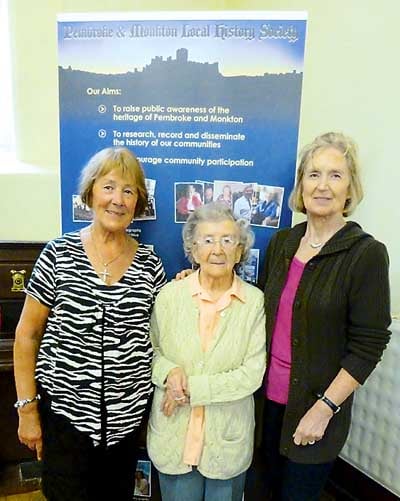
Ann Lankshear organised the proceedings which drew a large crowd of 76 people, such is the interest still in this event which happened so long ago. It is Ann's aim to bring people together to pool information and to record the stories, collecting information and photographs of the farms and cottages. Last year, John Russell gave his talk about life 'down below' before the military requisition and Ann invited him to first give us the background to that fateful War Office decision.
The reason why
John said that he was living at Loveston at the time and remembers the requisition coming as a great shock to the farming community with the resultant loss of 15 family farm homesteads. The news caused many objections not only from local councils, but also from those in Government. The Ministry of Agriculture objected to the taking of the most productive land in Wales, land that was well drained and level (hardly challenging for tanks), and an area which was beautiful and unspoilt. Despite it all, the War Office approved the range taking into account that the land not only had the advantage of the sea as a boundary but also was in the ownership of only one landlord, Earl Cawdor, which made the transfer of land so much easier. In all, a total of 5,757 acres comprise what we know today as the Castlemartin Tank Ranges: by the end of the war a rural landscape which had been centuries in the making was destroyed.


The aftermath
Ann then introduced five people to come forward to give their stories. They were May Roberts, Josie Thomas, Pam Morris, Betty Lyon, Tom Richards with Ann Lankshear and John Russell.
There were differing experiences, but for all it was a terrible blow - can you imagine it? To be told to get out of your home (a farm is not just a livelihood) and to find somewhere else at short notice with all the worry and stress it entailed. Some fared better than others, the first to go finding it easier to find vacant farms to lease - these were all tenant farmers of the Stackpole estate.
Betty Lyon's family farmed at Mount Sion and was one of the first to leave before 1939: they were fortunate to get a farm on the Angle Estate at West Pennar. Her cousin Pam Morris, however, told us how devastated her parents were to be given notice to leave Crickmail, a beautiful house and farm, for a dilapidated farm at Studdock. It was a terrible time for them and they really suffered. However, good fortune did shine on them to some extent in that her father was able to buy the farm at Goldborough, Hundleton where they were able to find happiness.
May Roberts recalled many fond and happy memories of life at Flimston Farm. But in 1939, her parents were given six months notice - fortunately they were able to take over a 270 acre farm at Orielton. While it did mean substantial downsizing they were able to accept the situation: her father describing it as 'a good, honest farm' which her brothers farmed until the 1980s.
Tom Richards's family had farmed at Trenorgan since about 1900 and he gave an interesting account of farming practices at the time of the requisition. It was a big shock and his parents had to scour Pembrokeshire for a farm. However, he was very philosophical about it as it did force his parents to go and buy a farm, which in the long term was a better thing.
Perhaps the most poignant tale was from Josie Thomas whose parents farmed at Newton Farm, near Bosheston. She remembers how in April 1941, a collection of high ranking army officers and men in bowler hats knocked on their door and served her father with only 28 days notice to quit the farm. Being one of the last to leave, finding a farm was very difficult but eventually they were able to rent Nantgwyn, four miles from Fishguard. It consisted of 129 acres that had seen nothing but sheep for 10 years: half the buildings had no roofs or doors and the house was in a terrible state. It was decided to take the farm, as there was no alternative, but her parents were never happy, sadly ending their days there.
We ride out on the Range
Following this, on Sunday, we went out on the range with the National Parks education service. Our guide was Pete Crane and we visited Flimston, Pricaston and Brownslade Farm (the house has been completely demolished). What a great loss: buildings dating back to Mediaeval times and productive farms, now in ruins in an uncultivated landscape. And such a breathtaking coastline, now out of bounds. But it was a hugely enjoyable day, with good companionship and to cap it all, the sun shone allowing us to fully take in the beauty of the landscape.
Next event
Tonight (Friday) at 7.30 pm in Monkton Priory Church Hall, we will be holding another of our popular quiz nights. £3.50 entry includes a lovely buffet. Bring a bottle if you wish.
Please note: We will not be holding a coffee morning next Saturday. We are participating in the jubilee celebrations in the castle where we have an exhibition 'Royal visits and celebrations in Pembroke'.
Contact
If you have any stories or photographs for this column, please contact me, Linda Asman, on 01646 622428, email [email protected]">[email protected] and visit the website http://www.pembrokeandmonktonhistory.org.uk">www.pembrokeandmonktonhistory.org.uk
Comments
This article has no comments yet. Be the first to leave a comment.