
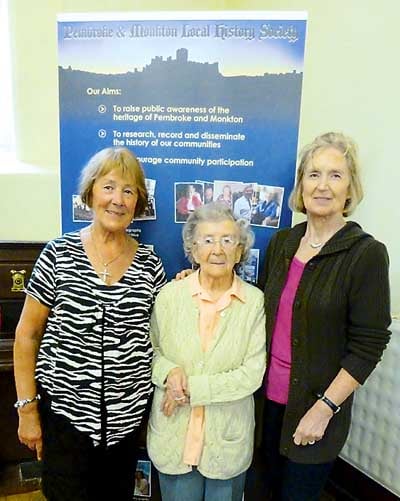
Our Saturday morning events are usually well attended, but on February 4, we were amazed at the response - so many of you turned up to the launch of our Pembroke Sense of Place leaflet. It may have been a horrible, dark wet day, but inside the Church Hall the atmosphere was quite the opposite.
Here I really must play tribute to Jacky Birthistle who organises the coffee morning, ably assisted by Jill Holmes, Florrie and Colin Friend, Liz Jenkins, Ann Lankshear and Pauline Waters - they were worked off their feet supplying coffees and cakes!
Back to the meeting; it was my pleasure to conduct proceedings, introducing our latest leaflet, Pembroke: a sense of place. There are few towns with such an auspicious history as Pembroke's and to convey this in such a limited space (1,800 words) was quite a challenge.
However, what I have endeavoured to do was to produce, as the title suggests, a sense, a feeling of what Pembroke was and how it has developed, rather than a detailed history.

And we have heritage to be proud of. It is a history which began some 10,000 years ago, when at the end of the last great Ice Age. Mesolithic hunter gathers took shelter in Wogan's Cavern and Cat's Hole Cave.
As the story unfolds through the ages, many peoples came and settled here. Pembroke rose to greatness when the Normans conquered in 1093, built a castle and established Pembroke as their powerbase for the area.
A prosperous Mediaeval Borough grew under the strong rule of the Earls of Pembroke.
Many of the great and glorious came here over the centuries: how many towns can lay claim to be the birthplace of a king?
More infamously Cromwell came to lay siege and bombard our Town Walls and Castle. The sea was Pembroke's life blood and we have a rich maritime heritage too. Pembroke was a port well into the 20th century, as well as an important agricultural centre. There is such a lot to our little town - read the leaflet to find out more!
George Lewis spoke next about his illustrations. Our society is greatly indebted to George for illustrating the leaflet and we spent a great deal of time deciding on what illustrations would be best suitable.
George decided against modern views; he wanted to use his artistic imagination to create scenes from Pembroke's past as they would perhaps have been.
"Every illustration that you have to do in a pamphlet of this sort requires a great deal of research," George told us, "I used for my source material, a combination of the murals I painted in the Town Hall, some from original paintings while others I drew specially for the leaflet."
George then described some of his drawings, including the Pembroke Fair which is pictured here.
"It is not," he explained, "a picture of the fair today, but as it perhaps would have been in Edwardian times: to make it authentic, Haggar's bioscope and Danter's are there -names associated with Pembroke. Also included are the helter skelter and swinging boats, very much part of fairs in the past."
It is surprising how much time and effort goes into the production of these leaflets - besides the painstaking work of the illustrations, there is all the writing and rewriting, the proof reading, the tweaking: here I must thank Kate Lindley, of Planed, who supervised the production and brought it to a satisfactory conclusion. I should add that this is our second leaflet; last year we produced Monkton: a Sense of Place and the two leaflets should be read in conjunction to give a more complete picture of Pembroke's story.
The leaflets, which are free of charge, are available from various outlets, including Pembroke Town Hall, TIC and the castle.
The leaflets are also available on our website to download - there are Welsh as well as English versions.
If you would like to know more about the artwork of George Lewis, please come to our annual general meeting which will be on Friday, February 17, at Monkton Priory Church Hall, at 7.30 pm. All are welcome and entry is free.
Our next Saturday event will be on March 3 - a St. David's Day special when we will be serving lunches, as well as coffees. Homemade Leek and Potato soup is on the menu, along with bara brith and of course, Welsh cakes. There will be an exhibition on Welsh costume with material on loan from Scolton museum. Entry is again free and will be open from 10.30 - 1.
Comments
This article has no comments yet. Be the first to leave a comment.