

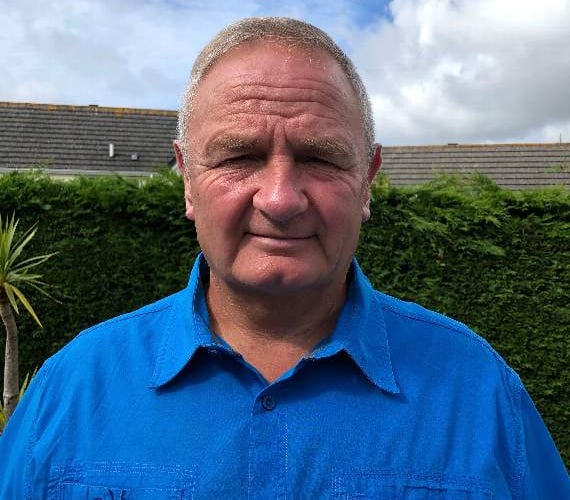
A father from Pembroke Dock who thought he had days to live said he can still remember the feeling of his new heart beat.
Fifty-six-year-old Mark Irwin, from Pembroke Dock recalls sitting in his car with his wife, thinking he wouldn’t survive another week.
That night, on June 2, 2012, Mark would receive the phone call that would change his life forever. He now wants to raise awareness of the importance of talking about organ donation, so that that more people can have the opportunity to receive the gift of life, just like him.
He said: “I remember as a young man having dizzy spells playing rugby. I reported my symptoms to my GP, but nothing was detected. One time during training, I collapsed and lost consciousness on the pitch and it was found that I had suffered an arrhythmia, an irregular heartbeat.

-with-Pembroke-Dock-Office-manag.png?width=209&height=140&crop=209:145,smart&quality=75)
Mark’s symptoms weren’t diagnosed as his symptoms at this time were only prevalent when exercising.
He said: “I continued visiting the GP, and they decided to look into why I was experiencing arrhythmias. Over the course of time, it was determined that I had Dilated Cardiomyopathy (DCM) and Arrhyhtmogehnic Cardiomyopathy (ARVC) both very rare diseases of the heart muscle, where it becomes stretched and thin meaning that it’s unable to pump blood around the body efficiently.”
Once Mark was diagnosed, despite medication, his health began to deteriorate when he developed an intolerance to the medication that he was taking to help control the arrhythmias.
He said: “I was experiencing arrhythmias on a weekly basis; my heart rate was very erratic, and I was blacking out. After a few months I had an ICD fitted – a small device that sends electrical pulses to regulate the abnormal heart rhythms. I was also prescribed medication, but this brought on thyroid issues and so I was advised to stop this medication.”
In 1985, when Mark was 20, he was told that he would need a heart transplant within the next five years or he wouldn’t survive.
He said: “I knew that the chances of finding a heart donor were slim and so I just accepted that I needed to look after myself as best as I could – though it was always in the back of my mind, I had to block it out. It was a really difficult time.”
Against all odds, Mark survived without the need for a transplant for 15 years, until changes in medication meant that his thyroid issues flared up again and his situation deteriorated rapidly.
He said: “I started having regular shocks from my ICD – sometimes two per week.
“One evening in June 2012, my wife and I drove down to Freshwater West beach to reflect and look at the waves. We hardly spoke, and I was so ill, I couldn’t even get out of the car. I didn’t think I would last the week.
“That night, as if in the hands of fate, just after 2am, my mobile rang - my transplant coordinator spoke and told me that there was an organ available, and that a taxi was 15-minutes away.”
On June 2nd, 2012 at 6.30am, Mark arrived at Royal Papworth Hospital to receive a heart transplant.
Mark went into the six-hour surgery and had what was described a ‘textbook transplant’.
Commenting on his operation, Mark said: “It’s such an invasive operation. Your heart is removed before they put the new one in, so they only have one shot to get it right.
“After the transplant, I was in hospital for 25 days, including accommodation in a flat on the hospital site for what’s called an ‘adjustment period’.
“I was suffering with anxiety after the operation, and had difficulties adjusting to the new organ. My old heart was so weak, that when the new powerful heart was in my body, I wasn’t in control of how it beats, and so often found myself catching my breath. That bit alone took a bit of adjusting. My father stayed with me during the adjusting period and after a few weeks, I began to recognize my new heart as my own.
Mark’s donor was a 28-year old female, who suffered with a blood clot in the brain.
He said: “I’ve written to my donor family, to thank them for the gift of life. Without them, I wouldn’t be where I am today. I wouldn’t have had the opportunity to see my children grow up or be around for the birth of my three grandchildren, and I’m forever grateful for that.
“I hope my story encourages even more people to talk about organ donation. I think it should be talked about, as early as in school, so that its not a taboo subject and more lives can be saved.”
As of June 2020, there were 13 people in Wales waiting for a heart transplant. People’s lives can be changed by a living donation, resulting in shorter waiting times, avoiding dialysis and an improvement to the quality and length of someone’s life.
If you want to donate your organs, it’s important to make a decision, register it by calling 0300 123 23 23 or visiting https://beta.gov.wales/organ-donation-campaign and also have “the organ donation chat” with your loved ones to tell them your decision.
Comments
This article has no comments yet. Be the first to leave a comment.