

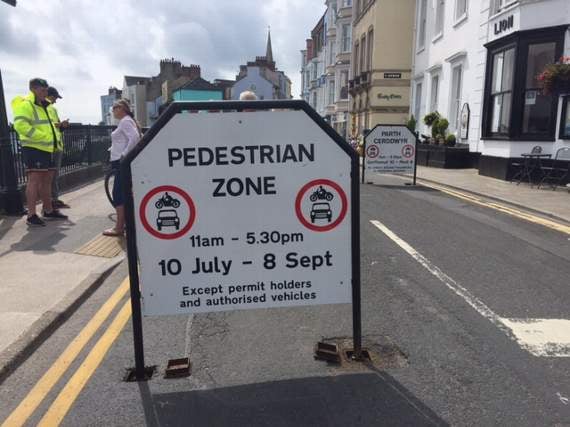
Pembrokeshire County Council officers have stated that they were ‘shocked’ to read the level of criticism aimed at them in the press recently from councillors in Tenby flagging up concerns over the running of this year’s pedestrianisation scheme.
The Mayor of Tenby recently called for an ‘urgent review’ of the town’s summer pedestrianisation scheme, after pointing out a number of failings that had occurred with the initiative over the 2017 holiday season.
The scheme prohibits unauthorised vehicles from entering the town walls between 11 am and 5.30 pm, during the summer, with restrictions in force to coincide with the school holidays.
Tenby’s Mayor, Clr. Mrs. Sue Lane, recently told her colleagues that a review of the scheme was required, as many people who had limited mobility who lived in Tenby and wanted to visit the town seemed to be suffering due to the ‘park and ride’ scheme being cut, suggesting that the county council either have the buses reinstated, or look at the scheme again, as it was discriminating against disabled people.




Following the criticism, councillors and representatives from PCC held discussions on the scheme at a recent meeting in Tenby, with Clr. Mrs. Lane explaining that since pedestrianisation had been established, the scheme had been ‘tweaked’ over the years and now seemed to overlook many conditions that were first brought in to help it run smoothly.
She said that since the cutting of the park and ride bus scheme from the North Beach car park, blue badge holders were having difficulty accessing the town, as there were limited spaces and time restricted parking which made it hard for residents and visitors to access areas such as the harbour in particular.
She appreciated that access for drop-off is possible, but if the driver is the disabled blue badge holder themselves then they are physically unable to access the area as they have nowhere to leave their vehicle.
PCC’s senior traffic engineer Ben Blake said that he felt the situation was no different during pedestrianisation or outside, as there was still limited parking and time restrictions affecting blue badge holders.
He added that additional parking spaces were provided on St Florence and South Parade during pedestrianisation to compensate for the suspension of the disabled bays within the walled town.
However, councillors felt that these were too far away from certain areas like the harbour to be of benefit.
Clr. Lawrence Blackhall said that he felt that there was an accumulation of different factors affecting access, including the cutting of the 380 town service as well as the loss of the park and ride from the North Beach car park, with Clr. Mrs. Rossiter, a blue badge holder herself, explaining that she used to visit the harbour using this service, but was now unable to during pedestrianisation, and was of the opinion that this was discrimination against less mobile residents and holidaymakers.
Clr. Mrs. Lane said that she had been looking into whether a ‘land-train’ could be used to provide a service in place of the park and ride scheme, and that the town council were due to meet with an operator for an initial survey and consultation into costings for such a service, with members of PCC invited to join the meeting.
PCC’s head of highways and construction, Darren Thomas, told the meeting that the authority had been shocked by the level of criticism aimed at them from town councillors in the local press recently regarding the pedestrianisation scheme, as they had always felt there was good dialogue open between the two parties.
Councillors stated another issue was that many people felt that more and more vehicles were being allowed in than ever before during the scheme, and were concerned that more seemed to be travelling through the core area of High Street and Tudor Square.
Mr. Blake agreed that there appeared to be an element of abuse and it was hard for the staff manning the entrance points at times and also where vehicles went after they had been allowed access.
Clr. Blackhall said this again raised the question of electronic bollards, coupled with fixed traffic lights on Crackwell Street, as in the long term it would save operational costs of the scheme.
Mr. Blake said that he had been investigating the possibilities, but due to the number of exemptions (e.g. emergency services), PCC could not use an ‘off the shelf’ system and some form of management would still be needed, but he was keen to explore the matter further.
Clr. Blackhall took the opportunity to ask as to the position regarding the introduction of byelaws to control non-licensable street trading in the town over the summer pedestrianisation period and in general.
Mr. Thomas said that he felt the whole issue of street trading and PCC’s policy in relation to this, was in need of a review, but admitted that street care and parking services manager, Marc Owen, and his department were very busy and this would take some time to complete.
In relation to whether or not PCC introduce a byelaw to control horse drawn carriage services in the county, the consultation had been completed and a report was being prepared for cabinet, with early indication seemingly in favour of a byelaw.
At Tuesday night’s meeting of the town council, Clr. Mrs. Christine Brown told her colleagues that they needed to ‘keep ahead’ of the outcome of the pedestrianisation meeting, otherwise PCC would just ‘shelve’ all the concerns raised and feedback they were given.
Comments
This article has no comments yet. Be the first to leave a comment.