
Archaeology Day
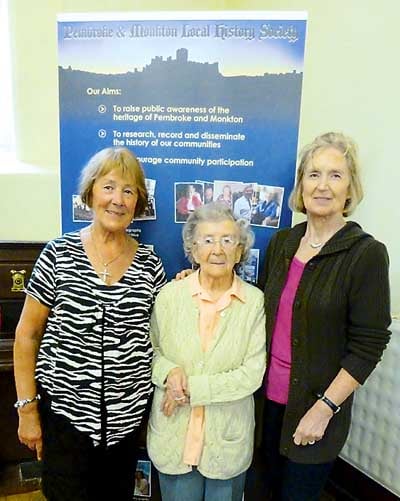
One of the main events on Pembrokeshire's 'history calendar' is Pembrokeshire Coast National Park's Archaeology Day. This is an event we as a society like to participate in and Stuart and I were there on Saturday with our stall - I think we took up rather a lot of space!
There were several talks - and one recurrent theme over the years has been Pembrokeshire's connection with Stonehenge. More and more is being discovered and new evidence was presented by Richard Bevins whose geological analysis has pinpointed the actual sites in the Preseli's where the stones came from - not Carn Meini as had previously been thought. Professor Mike Parker Pearson carried this further talking about how the latest findings had shed new light on life in late Neolithic (New Stone Age) Britain. It is now believed that the Salisbury Plain had been a gathering place for peoples from all over UK - from as far afield as Northern Scotland. These people drove their animals to Stonehenge to partake in great ceremony and feasting: an analysis of the bones discovered there have revealed this. All fascinating stuff.
One of the most interesting talks for me was by James Meek 'What did the Romans ever do for us!' He revealed that the first Roman fort to be discovered in Pembrokeshire has now been confirmed at Wiston, the first to be discovered west of Carmarthen. The Roman road from Carmarthen can be traced to Wiston and the question begs - where next?


The event was oversubscribed so if you want to get a place for next year's Archaeology Day make sure you book early. It is scheduled to take place on Saturday, November 15, 2014.
Boating on the Millpond
Back to Pembroke. Last week's pictures of boating on the Millponds evoked memories for many.
Mel Phillips was one - so I asked her to write them down to share with us.
"The boats were particularly popular in the early to mid-60s, but were still operational until about 1972. There was a mixture of craft, but my personal favourite were the cata canoe. These were small craft with a bar in the middle joining them together. There had to be two of you in the boat because otherwise you would go around in circles. You were given one paddle each. They were all brightly coloured and immensely popular because you could go like hell in them. Six pence for half-an-hour a shilling for an hour.
The council employee who sat in his council wooden shed had a megaphone to call you in when your time was up. There was also a token life jacket on a hook outside his hut. Health and safety hadn't been invented. All the little boats and canoes were numbered and you were also given a number when you set off.
On no account were you to take your craft underneath the bridge that led to the top pond because it was so shallow underneath the bridge that you could not avoid scraping the bottom of the boat. Of course, nobody paid any heed to the councilman and we used to make off for forbidden waters. We always headed to the top pond because as previously stated the water under the bridge was shallow, and secondly the top pond was dangerous as it was clogged with reeds. Shades of today's problems.
Lurking on the lefthand side of the bank of the top pond was Jack Scone's big black boar. His farm was near his lane (Jack Scone's Lane. Proper name Union Lane) and his pig cots were on the top bank of the upper pond. We were scared of the huge beast but we just had to see him. In my mind he still stands, massive, and menacing astride his bank.
We would then paddle the cata canoe back to the millpond where the council chap would shout and bawl at us.
My brother sometimes used to hire a larger canoe and then row out to about the back of St. Michaels' Church. Here the millpond path ended and there were only mud flats. The millpond path had yet to be finished at this time because the scheme was expensive and Pembroke was only allowed to complete it in stages because Pembroke Dock thought that it was a waste of council resources. (Pembroke and Pembroke Dock were one council then). Here Neil's mates would be waiting for him to pick them up for a free ride and they would all pile in and take it in turns for a free go.
Alderman Gwilliam
Some of the steps leading down to the water of the millpond were not created so that the boats could tie in although they did come in handy for this purpose. Sheriff Two Sticks aka Alderman Billy Gwilliam had created these steps for a purpose. The local daredevils having dived off the mill bridge used to climb up the wall by the Waterman's Arms in order to clamber out of the pond and back onto the bridge. The council tried in vain to stop them doing this dangerous game, but failed. Alderman Gwilliam then thought that if he couldn't stop them he would build them some steps so that they could access the pond easily. He was a clever and much respected councillor."
Shooting Lines
David James adds his memories of fishing on the Millpond.
"In my early teens I was an avid angler, cycling to anywhere that had water with fish in it. One place I fished at was the upper Mill Pond in Pembroke, but this needed insider information if success was to be guaranteed. During the spring tides, the sea would flood into the Mill Pond, including the top pond and Grey Mullet would enter the enclosed waters. As the tides fell to neaps, the tide would not go into the Millpond and the fish were trapped, unable to escape until the next spring tides. The fish would become quite hungry in the few days before this happened. Armed with this information (and a tide table), I would cycle to Little Gates at Pembroke's East End and fish off the stonework of the tunnel under the railway embankment.
Mullet were a strong fish and put up a fierce fight and often ended up as a nice meal. Very occasionally brown trout were caught at the same place. However, to catch these, I would go to the old stone bridge (how demolished as part of a road widening scheme) and using a live grasshopper as bait I would catch a nice brown trout or two.
With the construction of the river barrage below Pembroke, the big tides no longer bring their harvest of fish into the Millpond.
Jack House and his wagon wheel
Jack was a local character who had his own method of fishing the Millpond. In the Mill Bridge, there was a socket in the stonework. Jack's fishing tackle was an iron wagon wheel tyre with a circular net fixed to it, this was suspended from the end of a stout pole by a rope run through a pulley block. The method was simple but very effective, the pole was put into the wall socket, the circular net was lowered down to the bottom. Then he flipped small pieces of bread into the water until a large shoal of fish gathered in the right spot. The plan then was to grab the rope and run furiously across the road hoisting the net rapidly under the unsuspecting shoal."
Thank you Mel and David - any more memories, please share them and has anyone any photos?
Contact
If you have any stories, photographs or feedback for this column, please contact me, Linda Asman, on 01646 622428, email [email protected]">[email protected] and visit our website http://www.pembrokeandmonkonhistory.org.uk">www.pembrokeandmonkonhistory.org.uk
Comments
This article has no comments yet. Be the first to leave a comment.