
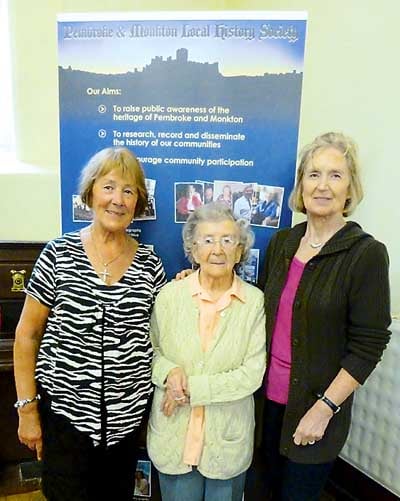
I meet the Captain of the Warrior
Sorry I missed last week's edition of the Observer – Stuart and I were off in the camper again, this time visiting Portsmouth Historic Dockyard. Many of you will be familiar with the Dockyard which is not only the foremost Maritime Museum in the country, but also of special interest to us in Pembroke and Pembroke Dock. For Portsmouth is now the home of HMSWarrior.
Yes the Warrior, once so familiar as a rusty hulk moored off Llanion, now lies resplendent in Portsmouth harbour attracting visitors from all over the world.
I wrote somewhat enthusiastically about visiting the Warrior last October and, as a result, was contacted by Ken Jones, Captain of the Warrior, who very kindly sent me a book (you see, the Observer reaches out far beyond Pembroke!).


Anyway, as we were visiting the Dockyard, I asked at reception if I might meet the Captain and we were invited aboard for a chat in his office.
The Captain
Ken Jones has been Captain for seven years and I asked if he would tell me something about his career and subsequent involvement with the Warrior, knowing the folks back home, who still harbour an affection for the old ship, would be very interested.
"I began my career as an electrical engineer," Ken began, "and after my degree I was employed by the Greater London Council working on various projects in London like the Thames Barrier.
"I later became a Naval Officer in 1974 and joined the staff of the RN Staff College at Greenwich."
Working for the Ministry of Defence, Ken rose to the position of Chief Executive Officer (second in command) of the naval air station at Lee on Solent, before retiring in 1999 as a Commander.
He continued: "I then worked for a City Livery Company for six years, before joining the Warrior Preservation Trust as Captain of HMS Warrior, following on from David Newbury in 2006.
"I was born only two miles up river from where Warrior was built - getting this job was almost like coming back home."
Ken's role as Chief Executive of the Warrior Trust is a demanding one, heading a large staff of 30 employees and 60 volunteers. "It is a busy job, and like all charities raising money, hosting events are important aspects," but he added, "it is interesting and I love it".
'Our' Warrior is in really good hands here - I liked Ken enormously and how generous to give up his time to talk to us, visitors from the Warrior's old home.
He also arranged for us to be shown around and we learnt a lot more about the ship from volunteer John Webb than we had from our previous visit.
The Mary Rose
The original objective of our visit to Portsmouth Historic Dockyard was actually to visit the Mary Rose. We had tried last year and found the opening of the new museum had been delayed, so we decided to try again before our ticket expired. (Tickets last for one year - there is so much to see here that you need more than one visit.)
Interest in the Mary Rose is immense and you have to be allocated a visiting time because of the sheer numbers flocking to see it. Of course, we in Pembroke have a special interest in the Tudors - how could we not have when their history began with the birth of Henry VII in Pembroke Castle?
The Museum
The old Mary Rose Museum has now closed and all the exhibits are in the new, multi-million pound museum which houses the preserved remains of the ship.
As you pass through dimly-lit galleries you can see the ship through windows on your right, while on the left are arranged artefacts in the position where they would have lain.
The conservation process, however, is not yet complete and the ship has to remain protected whilst drying out after years of spraying with water then polyethylene glycol. Once dry, the hull will be displayed in an open museum environment.
The end
of the battleship
As you enter the museum there is a large painting of the Mary Rose keeling over with the words written below – 'when their world ended, our story began'.
It all happened on July 19, 1545. England was threatened by an invasion of the French, who were lying becalmed and at anchor off the Isle of Wight.
The English fleet lay close to Portsmouth. Towards evening, four French galleys broke away from the fleet and rowed towards the English ships, firing their forward-facing guns.
In the skirmish that followed, the Mary Rose sank with 500 men, in full view of Henry VIII, who witnessed the event from Southsea Castle.
The loss was great. Henry must have felt it keenly as one of his first acts as King was to initiate the building of two new warships: Mary Rose and the Peter Pomegranate.
He was only 17 when he became King of England, his elder brother Arthur having died at the young age of 16.
His father, who had wisely steered this country in a course of peace and had amassed a considerable fortune, possessed only five ships. Young Henry VIII, dreaming of glory, used that fortune to build up his navy which, when he died 35 years later, amounted to 58 ships.
A glimpse into the Tudor world
Although fascinating in itself, what is so interesting about the Mary Rose is the preservation of so many artefacts from that far-off age which give us a real glimpse into Tudor life. Because of the speed of the sinking, there was no opportunity to escape (there were only 35 survivors).
The victims, along with their possessions, lay buried in the wreck for over 400 years.
Thousands of objects have been recovered: the simplest possessions of the poor sailors, their wooden bowls, plain clothing of wool, linen and leather, contrasting with the lavish lifestyle of the officers with their fine tableware of pewter, and clothes trimmed with silk.
Here can be seen the Tudors at work and play: the contents of the kitchen, the surgeon's cabin, the carpenter's workshop and all the various trades which make up the day to day life aboard ship.
Gaming dice, musical instruments, weapons and armaments - they are all here preserved for all time. Even the skeleton of 'Hatch', a small dog found in the doorway of the carpenter's cabin.
Raising the Mary Rose
I can remember seeing the raising of the ship on television, an event which caught the popular imagination.
To quote from an interpretation board 'On October 11, 1982, the Mary Rose surfaced to the sounds of klaxons blasting from the myriad of small vessels gathered to watch.
From Southsea Castle, where Henry had witnessed the sinking of his great ship 437 years previously, a gun salute could be heard.
Around the world 60 million people watched the longest television outside broadcast yet undertaken, as Mary Rose sandwiched between the lifting frame and cradle, was carefully lowered on to a barge for the short tow home to Portsmouth.'
Then, of course, began the long process of conservation, culminating in the opening of the Mary Rose Museum earlier this year.
Well worth the visit and I shall certainly be making a future visit when the drying out process is complete!
Next
Society Event
Our Local History Coffee Mornings recommence on Saturday morning (10.30 am to 12.30 pm) October 5 at Monkton Church Hall.
There is a change to the published programme.
Due to unforeseen circumstances, the family history talk has had to be postponed to November 2 and instead we will be going back in time to look at 'Before the camera: an artists view of Pembrokeshire'.
Comments
This article has no comments yet. Be the first to leave a comment.