
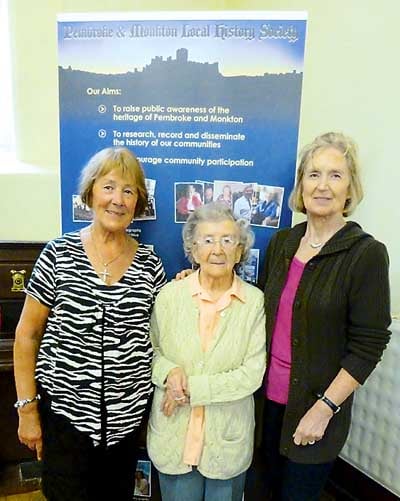
When Jeff and Pat James asked me to visit their Museum of Scrimpinology earlier this year whilst attending one of our events, I had no idea what to expect. As they only open it for two weeks in the year, they told me to book a date well in advance if I wanted to take along a party from the history society. Now I know why. The museum is a treasure trove of memorabilia, a real trip down memory lane - an amazing collection of household items, tools, games, everyday objects from the past as well as an old signal box and railway items, a mining section from Hook, school classroom and cinema equipment and even vintage cars. "Oh I remember that" was heard over and over again as everyone delighted in looking and handling objects remembered from our younger days.
Asked what prompted them to embark on opening up his own private museum, Jeff told me: "It all began 10 years ago. I was asked to display some old items I had acquired as part of the gardening club's open gardens day in July 2002. Then friends and neighbours added to the collection, wanting their old possessions to be seen rather than stored in attics and I began my search in antique shops, auctions and bric-a-brac stalls for more bits of memorabilia."
What an amazing achievement! To have gathered all this material together and more than that, to have organised and presented it a way to make it so accessible. I loved the humorous touches too - the lady with eyes which lit up in the telephone box, the legs poking out from under one of the cars. Such a lot of care and love has gone into it - and all done for love as no funding has gone into it. Thank you so much Jeff and Pat for a wonderful evening and for your warm welcome.
This is a private collection: Jeff only opens it to coincide with the Llangwm Scarecrow Festival which is held during the last week in June/first week in July and is by appointment only with groups. We will certainly be arranging another visit next year - if anyone is interested in coming along, contact me.
Monkton Priory
Along with some of our Monkton contingent, I met with Father Gildas, of Caldey Abbey, in Monkton Priory Church last week. Father Gildas has spent many years researching the religious communities and churches in Pembrokeshire and has a particular interest in the old Priory, the importance of which is not fully realised, he believes.
Monkton Priory was founded in 1198, following the Norman Conquest which saw the invasion and building of Pembroke Castle in 1193. Its history stretches back further as there is strong evidence to believe that the Priory was built upon an earlier christian site for christianity had entered Wales at a very early date, long before the conquest. Father Gildas was of the opinion that the monastery was very large accommodating not only monks but lay brothers and nuns. It would have been the administrative centre where the populace came to sort out problems and disputes, perform rites of passage, seek help for ailments. Around 200 people would have lived there. He believed strongly that the importance of Monkton Priory was not fully realised and there is much that needs to be brought to light. He added that what we have here is something very special.
We walked around the church to try to discover the extent of the old monastic buildings which must have been considerable incorporating the old hall, the abbey ruins and the priory farmhouse. A study of other benedictine monasteries could reveal a plan. Some of those present knew a lot more about Monkton Priory than I did and were able to offer information which it is to be hoped will be useful in Father Gildas's research. We afterwards returned to the church hall for refreshments. It was an enjoyable, fascinating evening - I think we all feel inspired to look further.
Priory Church Restoration
When the monasteries were dissolved under Henry VIII in 1535, the Priory Church continued to be used as a parish church although its condition gradually deteriorated until there remained only the long narrow nave.
The choir and sanctuary became a roofless ruin and remained so until its restoration at the end of the nineteenth century under the tenure of Rev. David Bowen who made the work of restoration his life's work while he was the incumbent from 1877 to 1926.
In so doing, the church revealed some of its secrets: the floor of the nave was lowered and hundreds of human bones were found, lying in a haphazard manner and a skeleton of a man was discovered walled up above the porch, in such a position to suggest he had been interred alive. Why this was remains a mystery. These remains were collected and re-interred in a large grave in the churchyard and printed here is a photograph which shows Canon David Bowen conducting the service at the re-interment.
Restoration continues
The Priory Church is now in great need of restoration, but fortunately there are still many who care enough to raise funding to maintain this beautiful building. Talking to Pauline Jenkins (Waters), who was born and bred in Monkton, I have come to realise the huge importance of the church in the lives of Monkton people who grew up here.
"Restoration is a continual process and ever since I can remember there have been fund raising events - flower festivals, jumble sales, ox roasts.... we have even abseiled down the tower! Social life revolved around the church and church attendance was high - I remember the church absolutely packed out at Easter. Our marriages took place there with wedding receptions at the church hall, youth organisations like brownies, guides, oys brigade were connected to the church, concerts were held there and the dances were hugely popular."
A new fundraising group has been formed and we need help to continue this on going task of restoration. Anyone is free to join in with this worthwhile cause - if you are interested contact me on 01646 683048 or Liz Jenkins on 01646 684277.
Comments
This article has no comments yet. Be the first to leave a comment.