

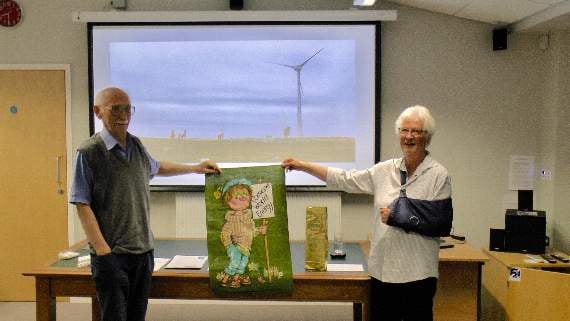
Pembrokeshire South East Energy Group (PSEEG) held its final meeting on July 20 with a talk by Janet Roberts (chair) on our changing climate.
The image which greeted members and friends was of planet Earth as seen from Apollo 17 in 1972. Extreme weather from around the world over the last few years was then shown. This included hurricanes, typhoons, droughts, record high temperatures, wild fires, record low temperatures and flooding.
Beautiful examples of vibrant life on coral reefs was then observed before seeing the reality of reefs affected by climate change. The same went for glaciers around the world. Looking at the Arctic and the way that global warming was placing the wildlife under increasing stress whilst the ice sheet on Greenland was reducing, was then displayed. Permafrost melting was causing the Inuit houses to be lost to the sea, blocks of flats in Siberia to collapse and the release of methane (a greenhouse gas) into the atmosphere.
In the Antarctic, a large portion of the Larsen C Ice Shelf (a fifth of the size of Wales) has recently broken off, whilst on the Brunt Ice Shelf Halley VI - the British scientific base which had been operational since 1956 - had to be moved because of a chasm opening up fairly near to the base. Unfortunately, another chasm - named Halloween - has now also appeared and for the first time in its 61 years the personnel has had to evacuate the base for their winter.




It was then shown that global warming had led to climate change and that the cause was directly due to the use of fossil fuels. A series of charts showed the rising temperatures and their connection to CO2 emissions. The most worrying chart showed that over the last 800,000 years CO2 levels had never been above 300 ppm - evidence taken from ice cores from Antarctic. Recently CO2 levels have reached 400 ppm - evidence from National Oceanic Atmospheric Administration. The warmest 10 years on record have been in this century except for 1998. 2016 ranks as the warmest.
For the first time it seems the term ‘expert’ has been used as an insult. However, the group would prefer to believe climatologists, meteorologists, environmentalists, oceanographers, glaciologists, geologists, hydrologists, marine biologists, ecologists and many more specialists who have spent their professional lives studying and understanding this subject.
A chart showing how contrarians or climate change deniers use a chart which shows consistently rising temperature is used and figures ‘cherry picked’ so that they can say temperatures have not risen in the last 16 years.
The group were then shown what they could do. As individuals, they could look at their own carbon footprint and find ways to reduce it. Nationally, the answer is sustainable renewable energy. Photovoltaics, solar hot water, biomass, hydro, geothermal, wind - both onshore and off-shore - should all be encouraged.
Swansea Bay Tidal Lagoon is being considered by the government at the moment. This follows a Government review which fully recommended its go-ahead. It would be a world first. Unfortunately, because the cost of renewable energy is paid by the energy consumer it could be considered too expensive. The total energy subsidy for 2014/15 paid by consumers was £3.5 billion. At the same time, according to the International Monetary Fund, the UK fossil fuel industry received £26 billion in subsidies.
Governments must be enpowered to invest and support renewable energy projects. In 2007, the UK led the world with the Climate Change Act when only four or five MPs voted against it. What has happened to that consensus?
The group then took a short walk down memory lane. Listed were the number of speakers booked, educational visits made, conferences attended, consultations taken part in, articles and letters in newspapers - both local and national. Talks were given to wide spectrum of groups.
Details and a timeline of the work involved in the wind turbine project at East Williamston was set out. PSEEG was involved from 2009 to 2014. The project is still going ahead under a very capable and experienced team.
Janet finished the evening by thanking the members and friends who had supported the group over the previous nine years. This included PLANED - who had started and encouraged PSEEG, PAVS, Environment Wales, Ynni’r Fro and Marten Lewis at the Darwin Centre. She thanked Neil Sefton for taking over as chair in 2013 and Philip Wathen for his valuable work on the website and taking on many behind the scene roles.
Janet Roberts will continuing to give similar talks to any group interested in this subject.
For contact details, see PSEEG’s website pseeg.org.uk
Comments
This article has no comments yet. Be the first to leave a comment.