

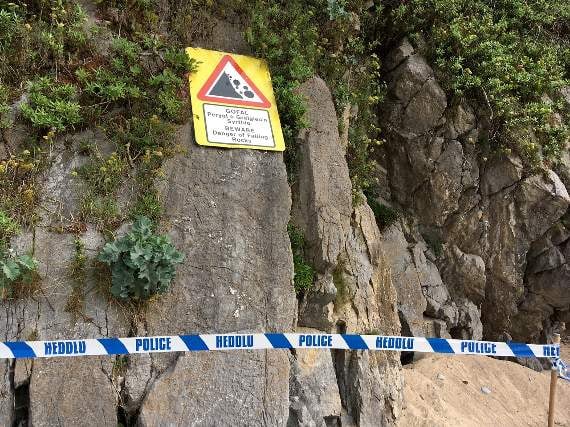
Netting or underpinning work could cause more problems for Tenby’s cliff faces due to the nature of the rocks, local councillors were told by a coastal engineer at a recent meeting to discuss concerns regarding cliff stability and safety around the resort’s beaches.
Pembrokeshire County Council coastal engineer Emyr Williams met with members of the town council last week, as there had been concerns raised regarding several rock falls, particularly on the South Beach, in recent months.
At the meeting, Mr. Williams said that the main area of recent falls had been the South Beach, which after having no problem for a number of years, had experienced a number of rock falls over the last 12 months.
He explained that the whole rock face, due to its geology, was broken and fragmented and, being limestone, dissolved over time. This resulted in fissures eroding and expanding to a point of failure.



He said that even if PCC removed or ‘scaled’ the rock face back, it would just expose more fissures due to the fact that the cliffs formed part of the ‘Ritec Fault’. Vegetation did assist in binding some of the looser rocks, but added to the problem in that roots expanded the fissures and when the plants died off, it left more of the ‘cracks’ exposed to erosion.
Mr. Williams said that there were few problems with the general stability of the cliffs on which the town was set and explained that the presumption was that, land above the cliff was the property and responsibility of the land owner down to mean high water mark, and that there were indeed areas of Tenby with property or land in private ownership on the cliffs.
Areas of land from First Point to Crackwell Street under PCC control had been netted and pinned, but some areas, for example below Park Hotel or on The Croft were private ownership.
Mr. Williams said that the area above the inshore lifeboat station where there had been a landslip was also outside PCC’s remit and he believed this matter was being resolved privately.
While acknowledging the falls on South Beach, PCC had taken the view that definitive ownership was difficult to prove, and that netting or underpinning work could cause more problems due to the nature of the rocks and be cost prohibitive, and as such PCC had erected warning notices.
In relation to the erosion of the dunes on South Beach, Mr. Williams said that the sea was trying to realign itself on the historic Ritec estuary, and unless the landowners in this area were prepared to make major investment, all PCC could do, in light of projected rises in sea levels over the next 60 years and Welsh Government advice, would be to allow nature to take its course.
Speaking at Tuesday night’s meeting of the town council, Clr. Laurence Blackhall told his colleagues that it had been a really useful meeting and that they were grateful to Mr. Williams for his expertise in providing some answers to the concerns on cliff stability.
“The key thing is that properties overlooking the cliffs which are responsible for certain areas, need to look at their insurance from a safety point of view, as there is a liability,” he commented.
Comments
This article has no comments yet. Be the first to leave a comment.